“Tochka Cuire” festival · Press centre
“Tochka Cuire” festival press conference
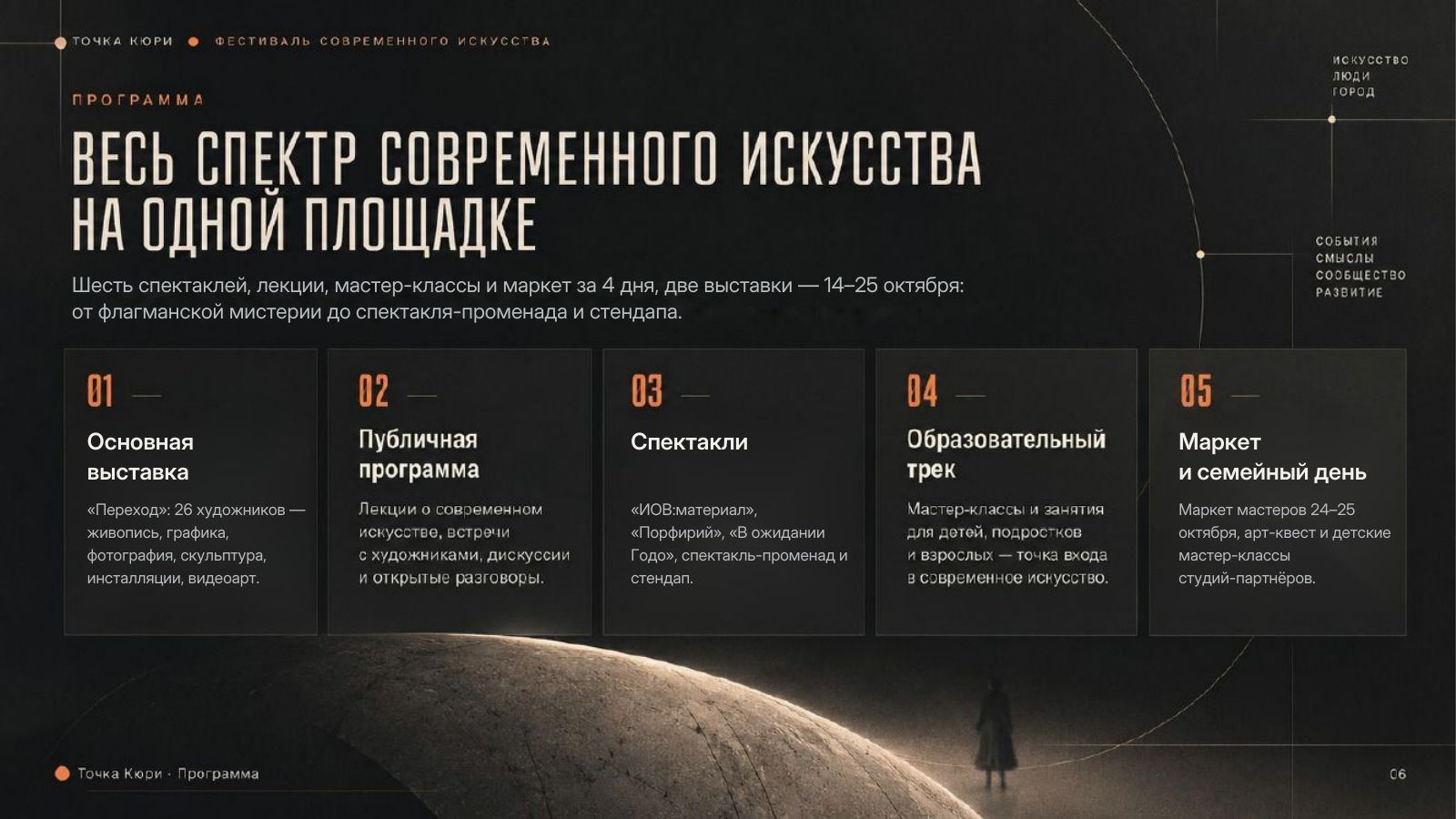
The festival team spoke about the concept of the first season, “Transition”, the exhibition, the theatre programme, sound and the fashion show, and answered journalists’ questions. Here you will find the video recording, the full transcript and the festival presentation.
Festival presentation
Transcript
The transcript was edited by hand: names, titles and figures were checked against the press conference script and the festival programme. The press conference was held in Russian; this is an English translation.
Download transcript · PDF, 160 KB- 01:29
- Time from the start of the recording — click to watch the video from that moment
- (?)
- Uncertain word
- […]
- Inaudible
- presumably
- In the Q&A, the speaker is identified from context
Sections
Opening
Members of the media, guests and participants of our press conference! We are glad to welcome you to the Byl Centre for Contemporary Art for a conference dedicated to the “Tochka Cuire” contemporary art festival. This year the festival is held here under the title “Transition”. It is a very interesting and relevant theme for us, one that sounds especially relevant today in our region and in our country as a whole. The world is changing, cities are changing, we are changing, everything around us is changing. And the ways we interact with the world around us and with reality — all of that is changing too. We need to respond to it, to understand how it all moves, and to find our own place in that movement.
For the Byl Centre for Contemporary Art it is important to be a space where art is not only shown and where people can come and get to know […], but where conditions are created for new ideas, experiments and encounters. Today we will introduce the festival team of “Tochka Cuire” and tell you about the festival concept and its art, theatre, music and other programmes. And after the press conference we invite you on a tour of our exhibition, so that you are even more in the know and more immersed in the context.
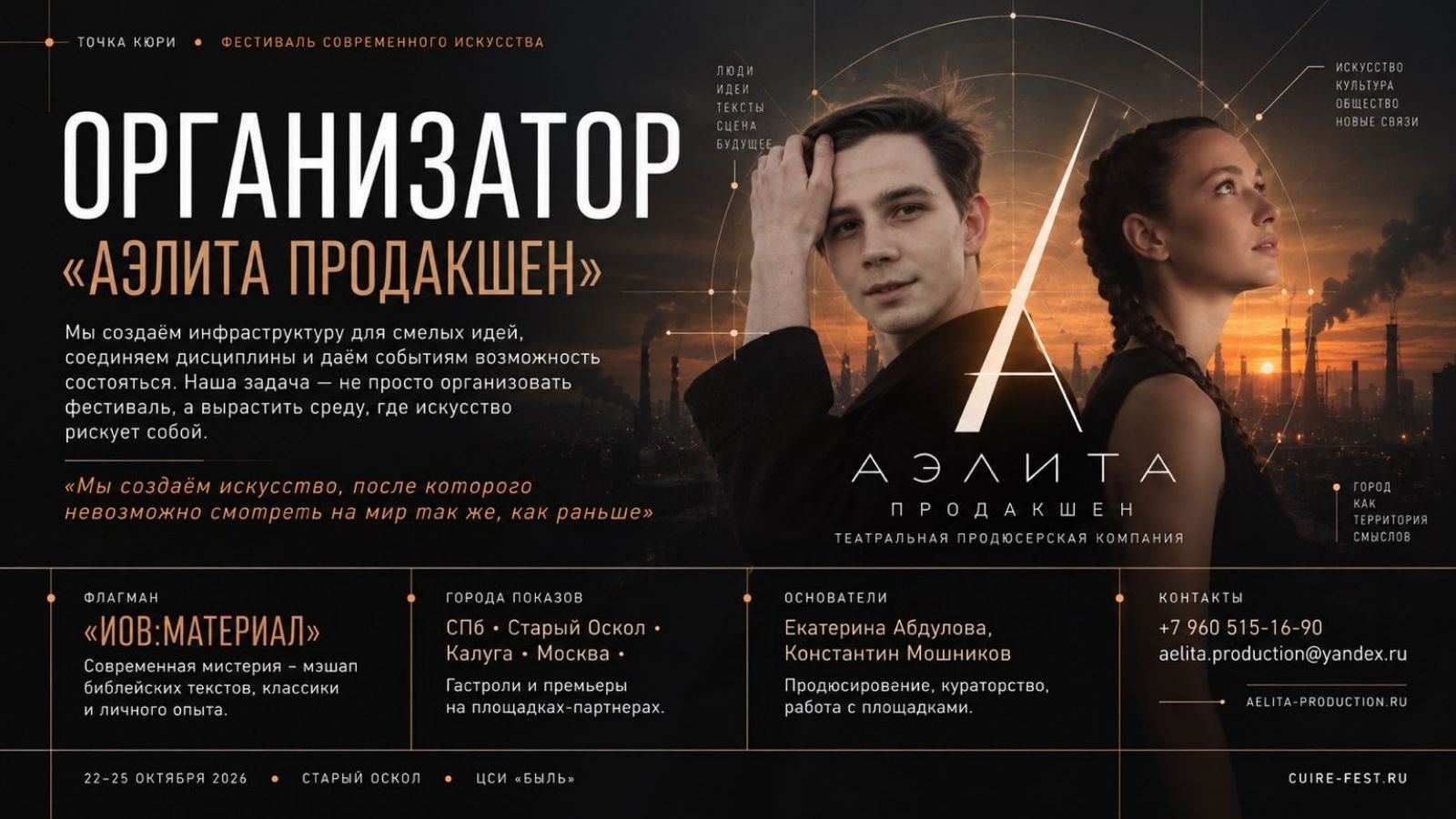
So, everyone is ready, everyone is already impatient. I would like to introduce the festival team and our speakers. Ekaterina Abdulova — curator of the “Tochka Cuire” festival, head of the production company AELITA PRODUCTION. Please meet her. Ekaterina Shelgunova — curator of the exhibition programme and the art exhibition “Transition”. Viktor Ignatov — you most likely know him — curator of the theatre programme. Kseniya Shamarina — curator of the music programme and the fashion show. And I would also like to introduce Olga Aleksandrovna Kovalchuk, deputy head of the Department of Culture of the Stary Oskol City District Administration. At the very beginning, of course, I will give the floor to Olga Aleksandrovna as a representative of the Department of Culture, to give us her blessing, to open, so to speak, our movement and set off in the right direction.
Good afternoon, dear participants and team! Of course, I would like to say words of gratitude for organising such a festival, especially here in our district. As […] Aleksandrovna said, this is a first. We hope the festival will continue, grow even bigger and better, and that there will be many spectators. The festival starts on the 22nd, right? So, taking this opportunity, we invite everyone to the opening of the festival, and the whole team will now tell you what interesting things await us during this period. I would like to wish you luck in running the festival, new inspiration for future events and, of course, success. Thank you very much.
Thank you, Olga Aleksandrovna. Let us start our dialogue with the main question: how did the idea of the “Tochka Cuire” festival come about, and why is its first season dedicated to the theme of “Transition”? I hand over to Ekaterina Abdulova.
Festival concept
Hello. I don’t even know where to start. I really want to tell you the living, real story of how we came to be here.
I live in Kaluga. It is not a big city, a little like yours — a population of about 300,000. A few years ago I became the producer of two festivals: one is a contemporary art festival called “Tsiolkovsky”, and the other is a festival of creative industries. Over these few years I have produced five festivals. And for a long time I watched the artists who were residents of our festival, and I always felt very sorry that many of their works were made as festival pieces: shown once and then put away in a drawer.
That is how our production company came about. We started creating projects as a production company and touring them. We have toured to the Alexandrinsky Theatre and to Moscow, and played at many independent venues of all kinds. And every time we created a big cultural event — like a festival that brings together 10,000 people — we ran into a lot of problems within the team that turned out to be unsolvable. Because when you hire someone and pay them a salary, you usually have very little time to find a common language.
When we do projects with our now well-established team, I am always very happy, because I don’t need to explain anything to them. I come to Ksyusha and say: “Ksyusha, I want to make a show.” And she says: “Coming right up.” Ksyusha is a composer. She sends me music, and it fits the show exactly. She hasn’t even read the script yet, and she has already sent me a link to Yandex Disk. I listen — and I’m delighted. It is the same with lighting designers, set designers, actors. It didn’t happen overnight.
And then a few months ago I came to visit you and fell in love with your city. It is absolutely amazing, very beautiful, with an amazing identity. You are an industrial city, and yet the people we dealt with seemed very lovely to me — from the tram drivers to the women who rented us a flat and fed us. Wonderful people. Vitya showed me the venue, and I liked it very much too. At first we wanted to bring just one show here, but in the end I came home, told the team about my trip, and they said: “Let’s make a festival.” I said: “Let’s.” And here we are. Only two months passed from idea to realisation.
We are very grateful to the venue, because they helped us a great deal with the installation. Mikhail is somewhere here — we would not have survived without him at all, he spent two days with us installing all the exhibitions. We are very grateful to the Department of Culture, because without their support and help nothing would have happened either.
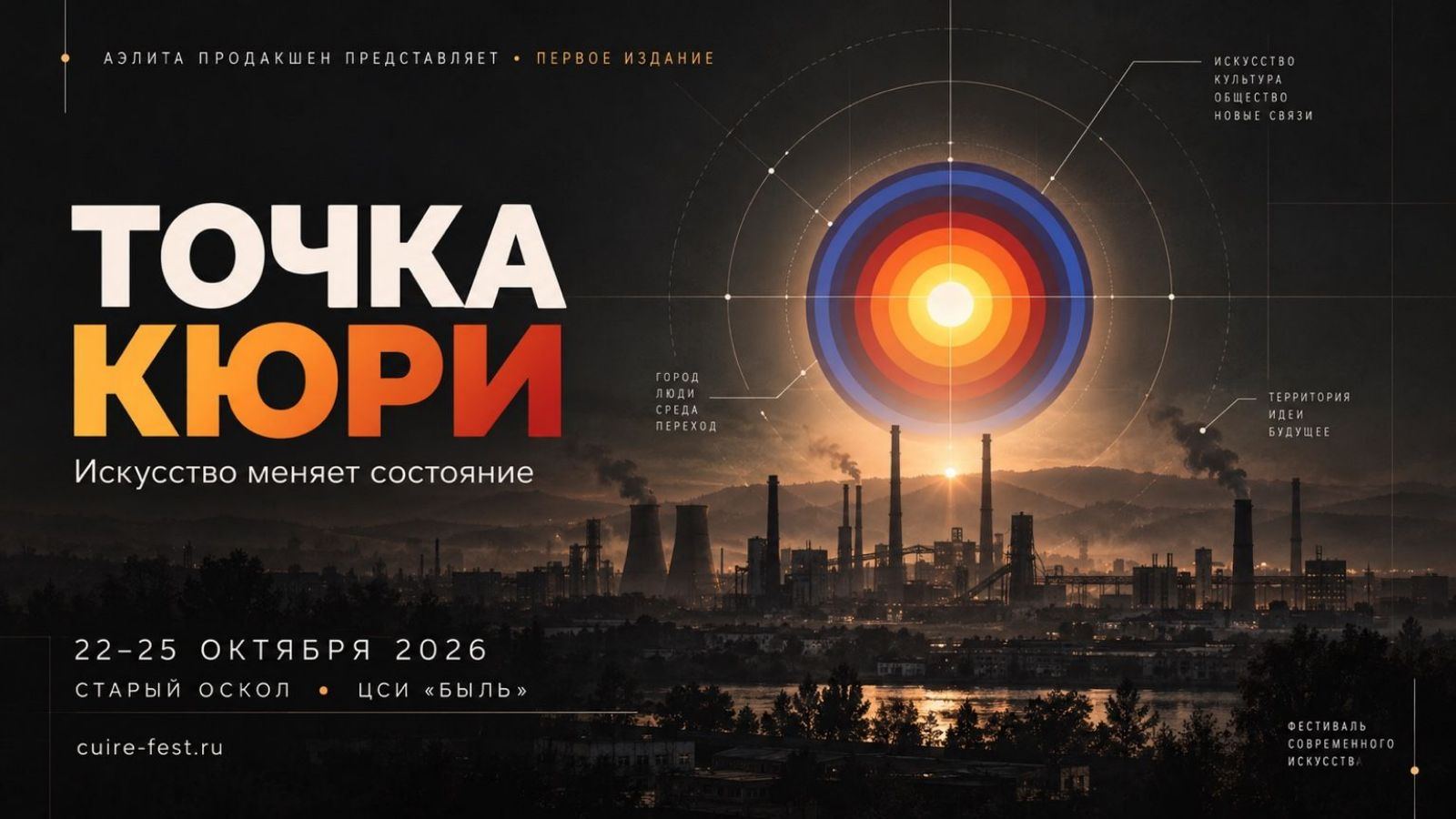
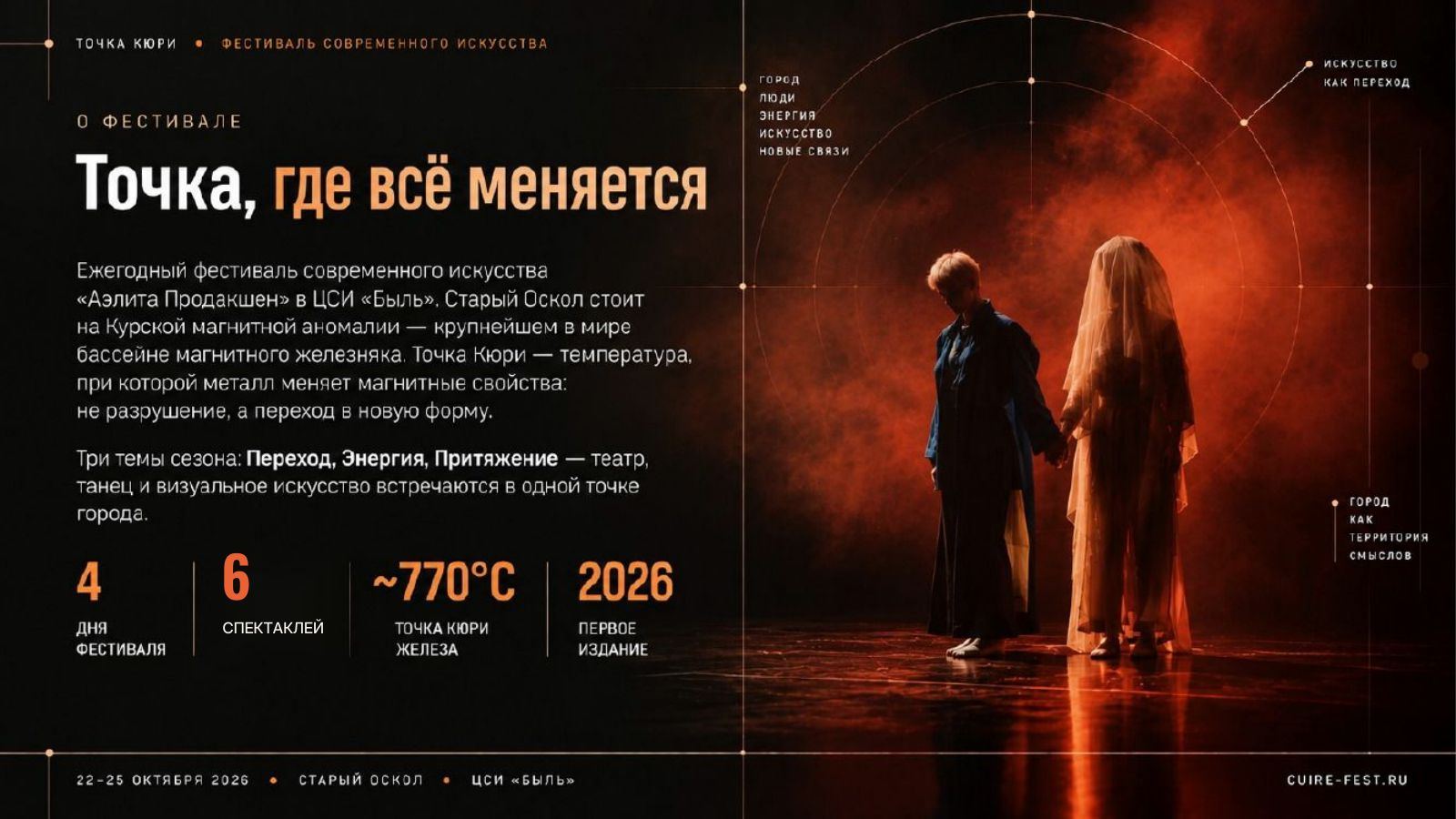
Now let me tell you a little about the festival itself and what awaits you. One of the reasons we chose your city as the place for the festival: you sit on the world’s largest basin of magnetic iron ore. There is a concept called the Curie point. It is the temperature at which a metal changes — not loses, but changes — its magnetic properties, and matter changes its form.
The whole world is now living in conditions of uncertainty. The world is changing very fast: what seemed impossible yesterday becomes our reality today. Artificial intelligence is developing rapidly, a huge number of things are happening. If 200 years ago a woman could pass on to her daughter a body of knowledge that would last her a whole life, then today — by the time I was born, I was already outdated as a model for the new world. We are constantly acting under uncertainty, and I would like us to learn to live in it. Not to exist, not to survive. For the last five years or so we have been living with the thought that any moment now this will end and our life will go back to how it was. We live in waiting, in hope — and we are never here and now.
We treat the festival, and any cultural product created by our production company, not as entertainment but as a tool for changing our way of life and our picture of the world. I sincerely believe that an artist is not a person who describes reality: came, saw a landscape and started painting. No, an artist is a person who creates the reality in which we all then live. This is easy to prove if you remember the films you watched as a child, the books you read, the paintings you saw. After all, all our ideas about how human relationships work, how one should love, what marriage is, why it should be monogamous — they did not arise in our heads on their own. Most often we picked up the ideas we operate with somewhere in childhood: in the family, in the yard, in a book, in a film. An artist is a person who creates reality. And art — fortunately or unfortunately, that is how it has historically turned out — carries a very big mission: reflecting on what is happening to us, inventing new ways and forms of life, a new language, new words. Everything we feel, experience and think, we think in some words, in some terminology, and all those words were invented by artists. Even a tech entrepreneur is still an artist at heart.
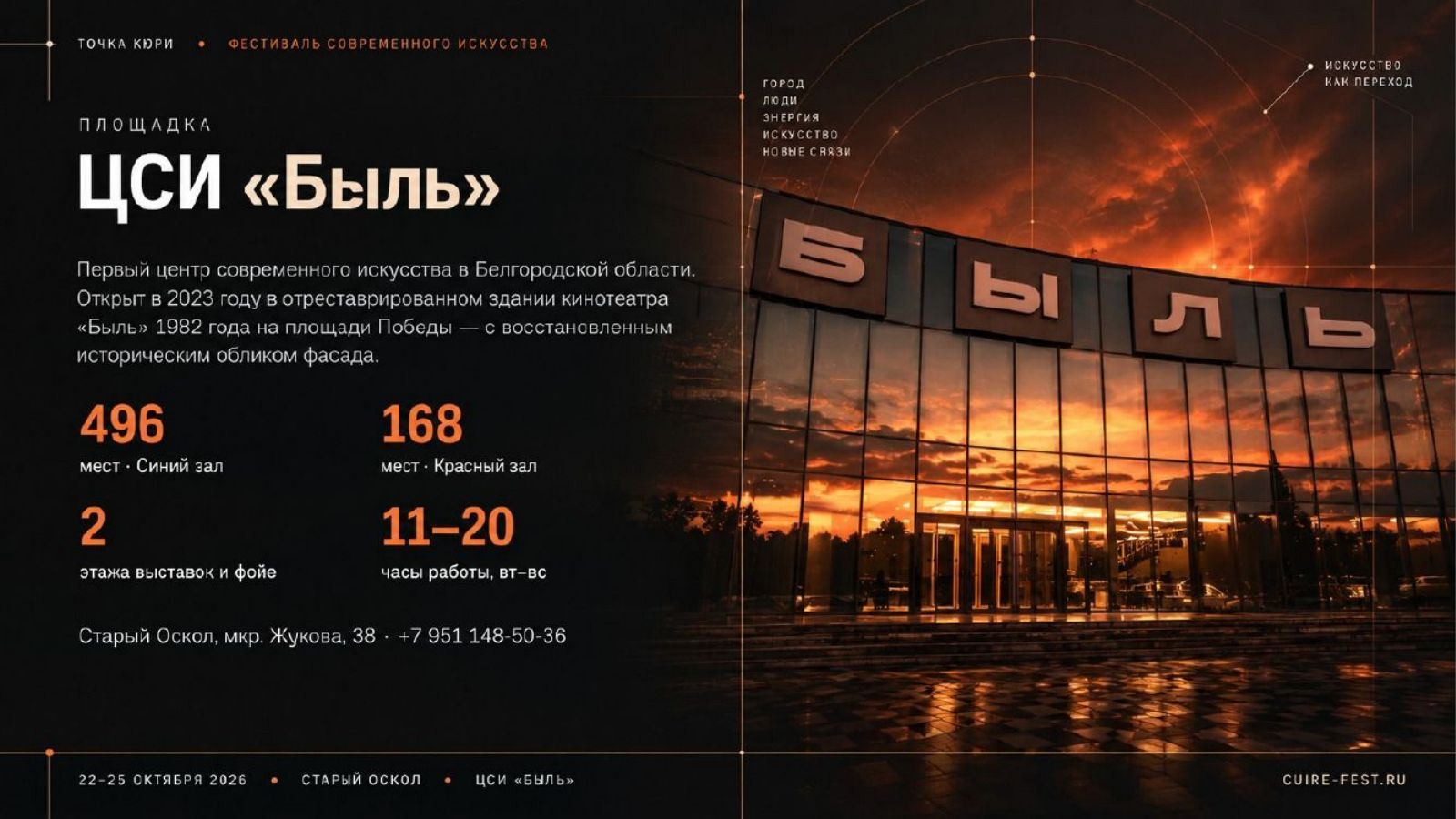
The venue is absolutely amazing. We will have two exhibition spaces: here, on the second floor, the art exhibition, and on the first floor the photo exhibition. Also two halls — one with 168 seats, the other with 496 — where the theatre programme will take place.
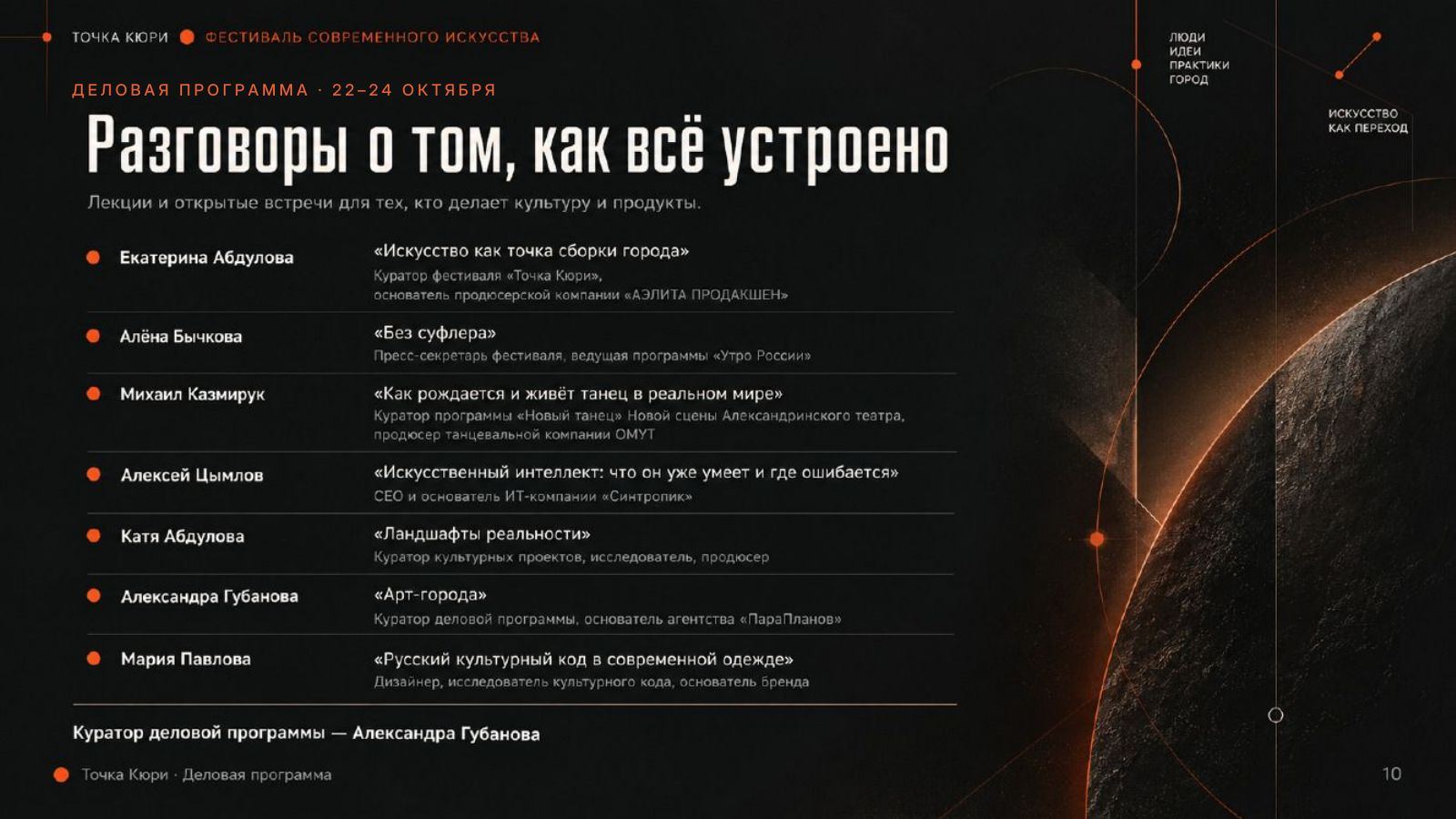
We have brought you completely different strands of contemporary art: exhibitions and a business programme — a very interesting one, you can find it on the website. There will be an educational track and a lecture part. Coming, for example, is Misha Kazmiruk — chief curator of the “New Dance” programme at the New Stage of the Alexandrinsky Theatre; he is coming to us from Saint Petersburg. With him comes Nadya Kokhanova — one of the leading choreographers in our country. She creates her projects at the Alexandrinsky Theatre and at GES-2 in Moscow, and works at all the best venues in the country. She will hold a contemporary dance workshop. We have brought shows — Vitya will tell you about them a little later. The head of […] is coming, a […] journalist is coming, quite a lot of people are coming who will give lectures on completely different topics.
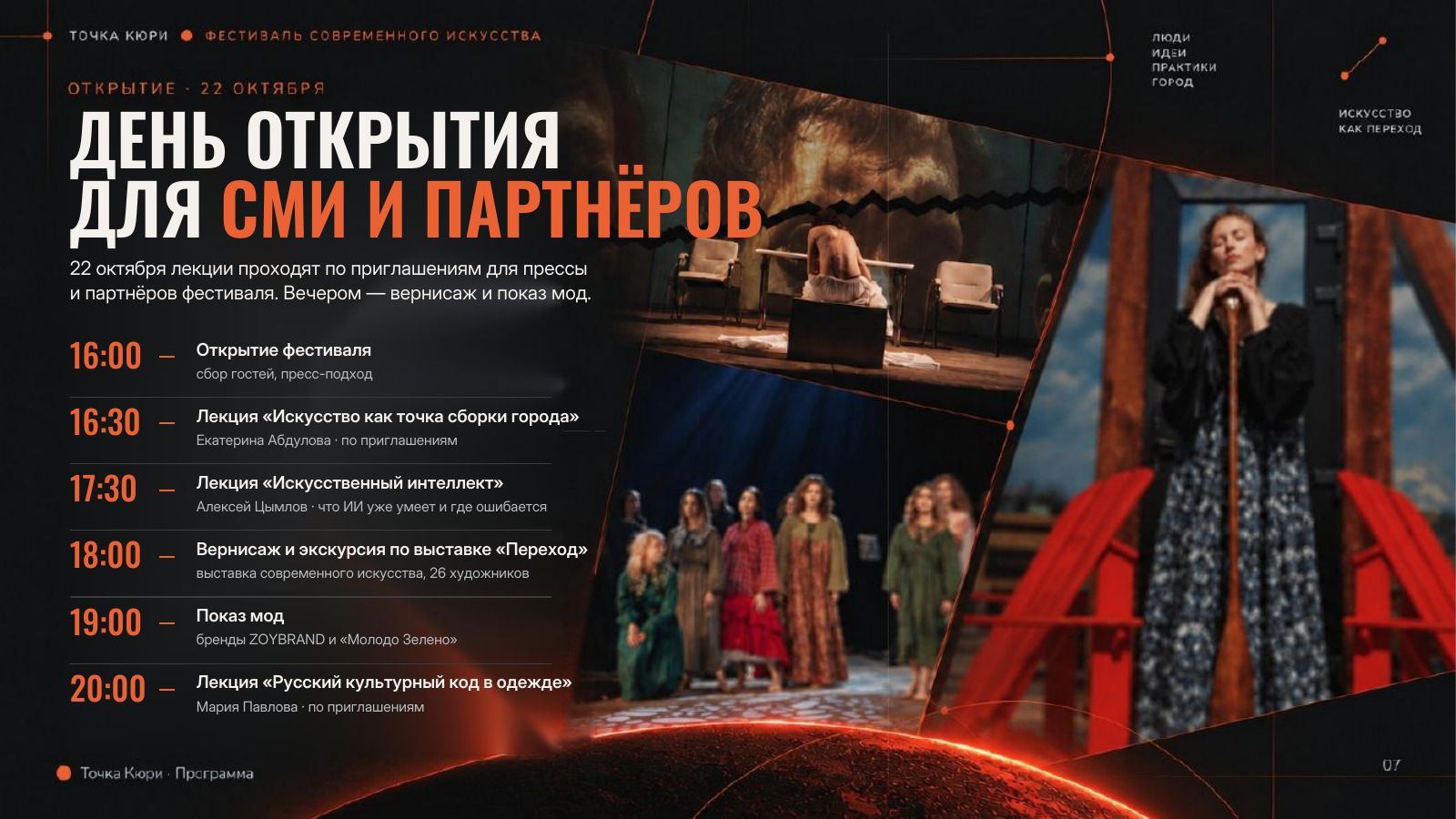
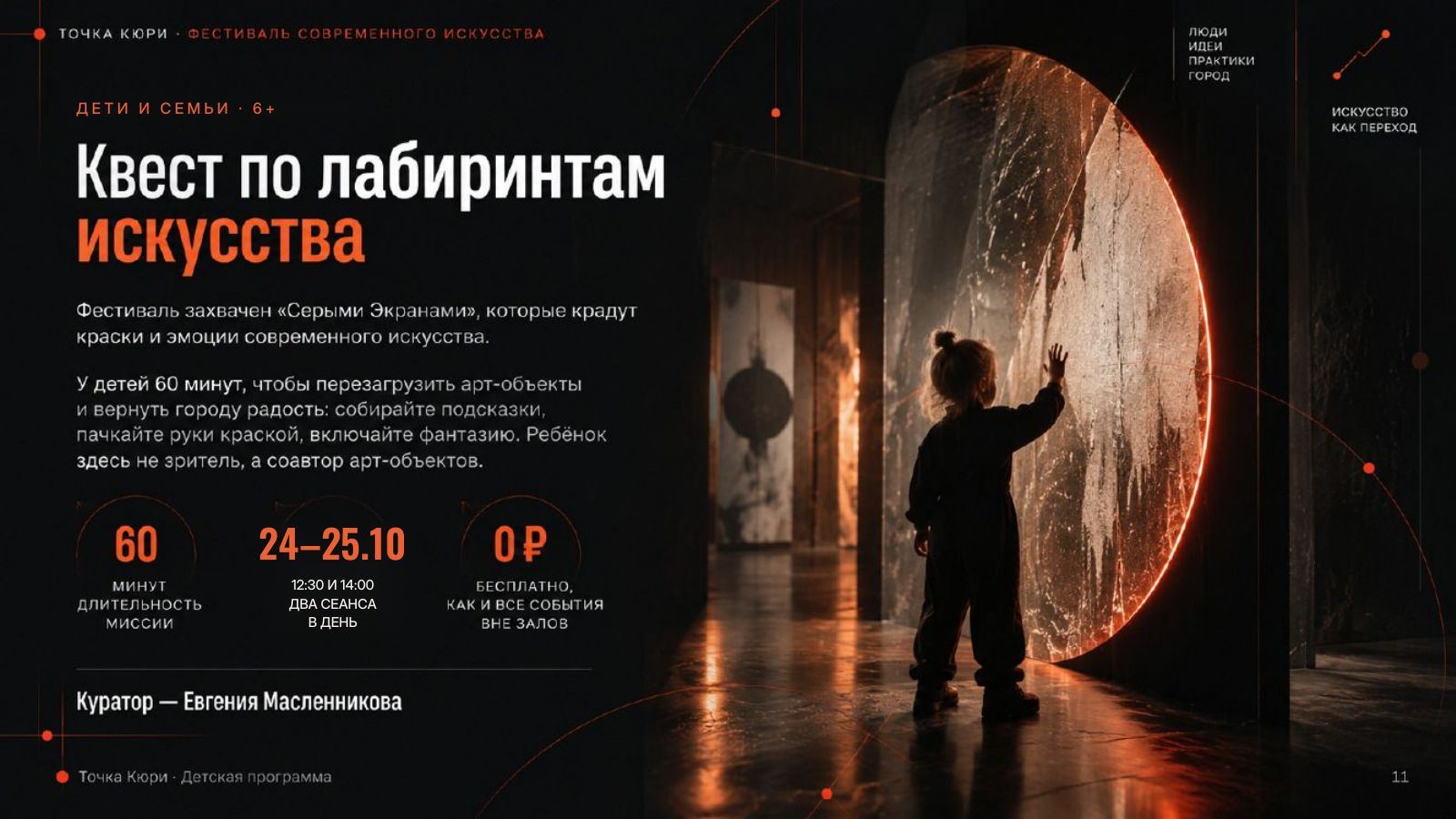
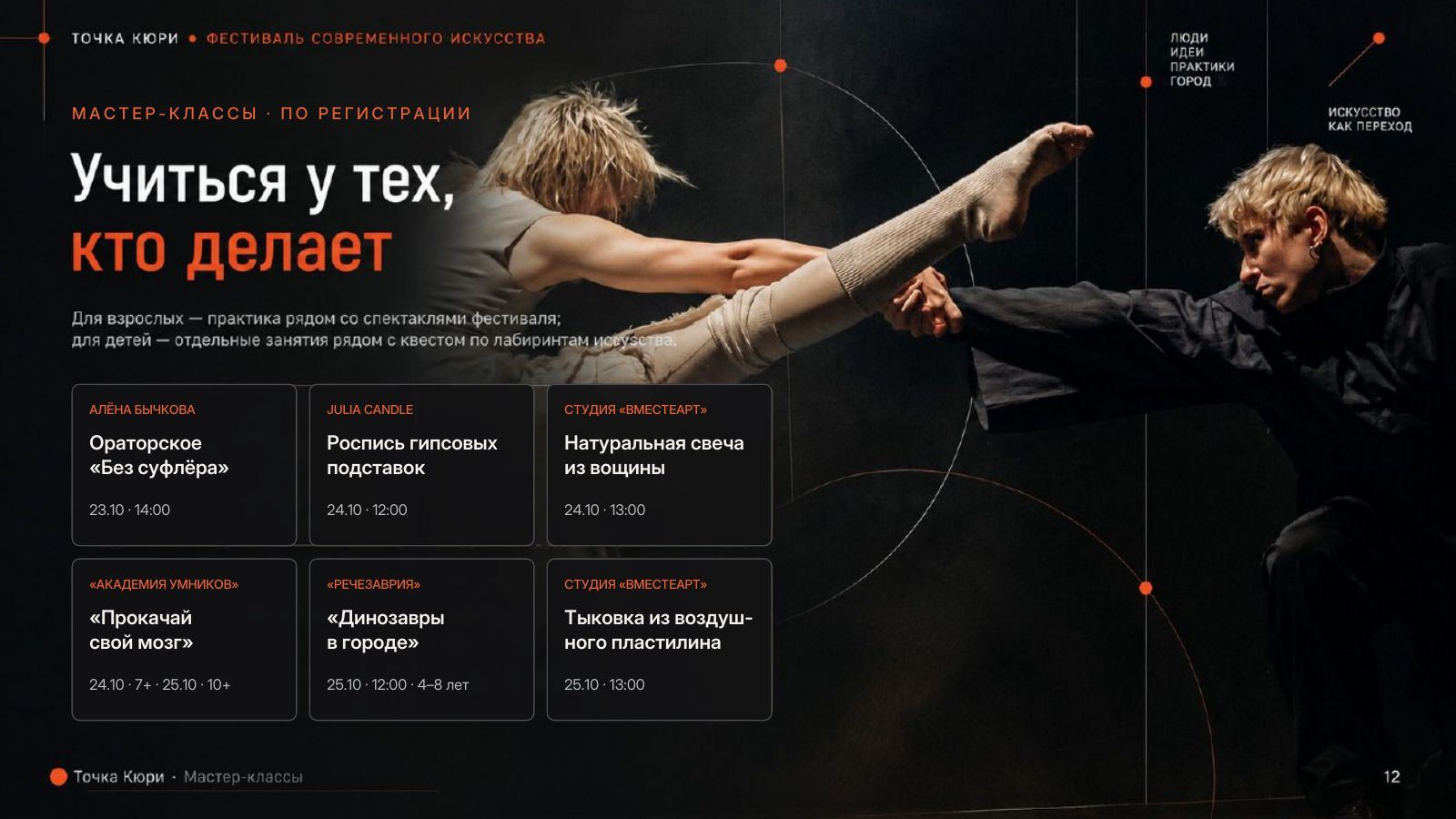
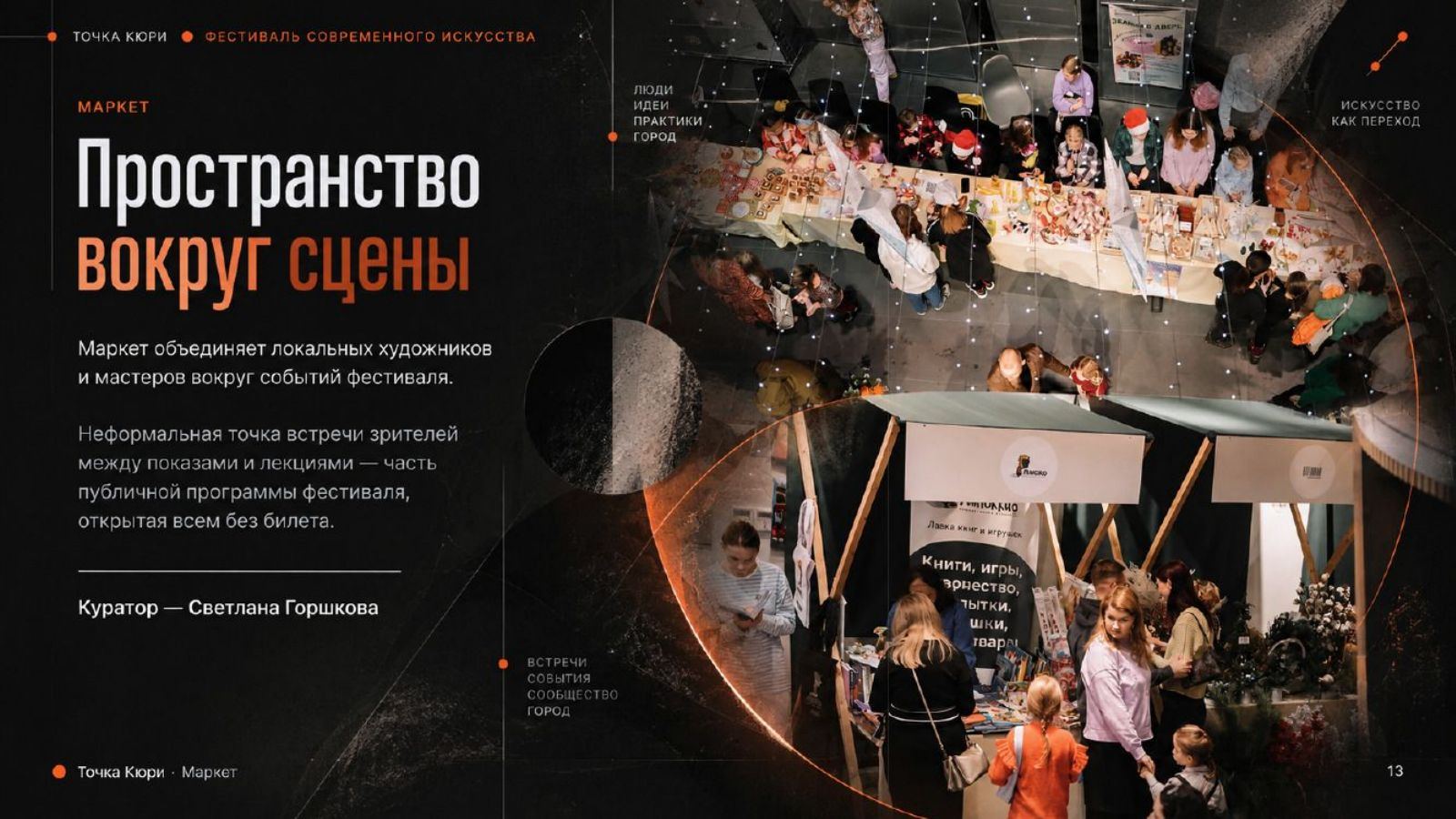
Also on Saturday and Sunday there will be a market. There will be an extensive children’s programme: we will run several children’s art quests where kids become participants in the creative process. There will be workshops for children and adults where you can make something with your hands or learn something — public speaking, movement. Once more about the programme — in a bit more detail. On October 22 there will be a closed opening of the festival. Unfortunately, you can only get in with an invitation. I will give a lecture on how art brings together completely different spheres of a city’s life and becomes a point around which the city gathers. In Kaluga we have already tried this over several years: organising not only cultural but also social, public and urban life.
Lyosha Tsymlov is coming — the founder of the company Sintropik. It is quite a big company, now carrying out projects in artificial intelligence, and together with him we are testing the integration of artificial intelligence into art. For example, at the Kaluga Youth Theatre, at the end of the season, he wrote a program that we trained on textbooks by leading Russian directors — […], including Semyon Mikhailovich […] (?), whom you all know well. And at first it ran rehearsals, and then it ran some of the performances. Lyoshka created this thing, and he will talk about how artificial intelligence works now in big companies, how it works in art, where it gets things wrong and how we can make friends with it.
Then we will hold a full, big tour of the exhibition. Then there will be a show — a fashion show. Three brands are coming to us: ZOYBRAND, Masha Pavlova’s brand “Molodo-Zeleno” and “Mama, khochu plat’ye” (“Mum, I want a dress”) — that is children’s clothing. Our wonderful modelling agency will join in and help organise the show. And then the designers, in particular Masha Pavlova, will talk about how the Russian cultural code is realised in contemporary clothing. Here there are photos from my show and from the previous show […], which we also did as part of a festival.
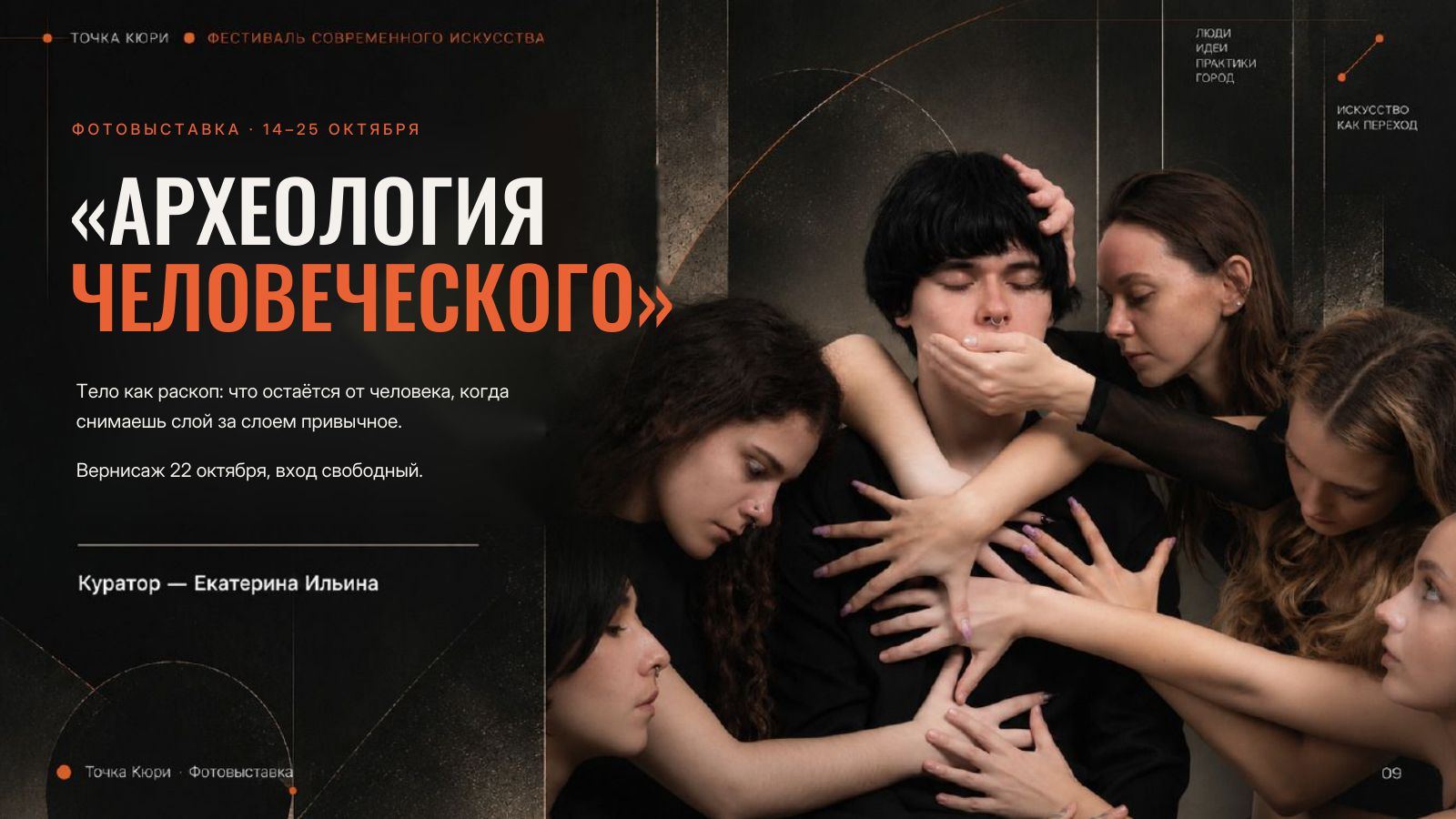
The exhibition “Transition” — Katya will tell you about it now and even show it. Also on the first floor hangs Katya Ilyina’s exhibition. We had a big project called “Archaeology of the Human” — a series of one-act ballets created together with the dance company “Koroche”, and we did a photo shoot. This photo exhibition explores what remains of a person if you strip away all the cultural, social and historical scripts. What would be left of us if our cultural habits, social norms and demands were taken away? You can see it.
The lecture part is also all available on our website. There will be a children’s art quest, a series of workshops, a market. And the theatre programme — we will tell you about it now as well. That’s the story. Thank you.
Thank you very much, Ekaterina. We have heard the overall concept of the festival. And now we would like to talk about how the theme of transition is embodied directly in works of art. Ekaterina, the floor is yours.
The “Transition” exhibition
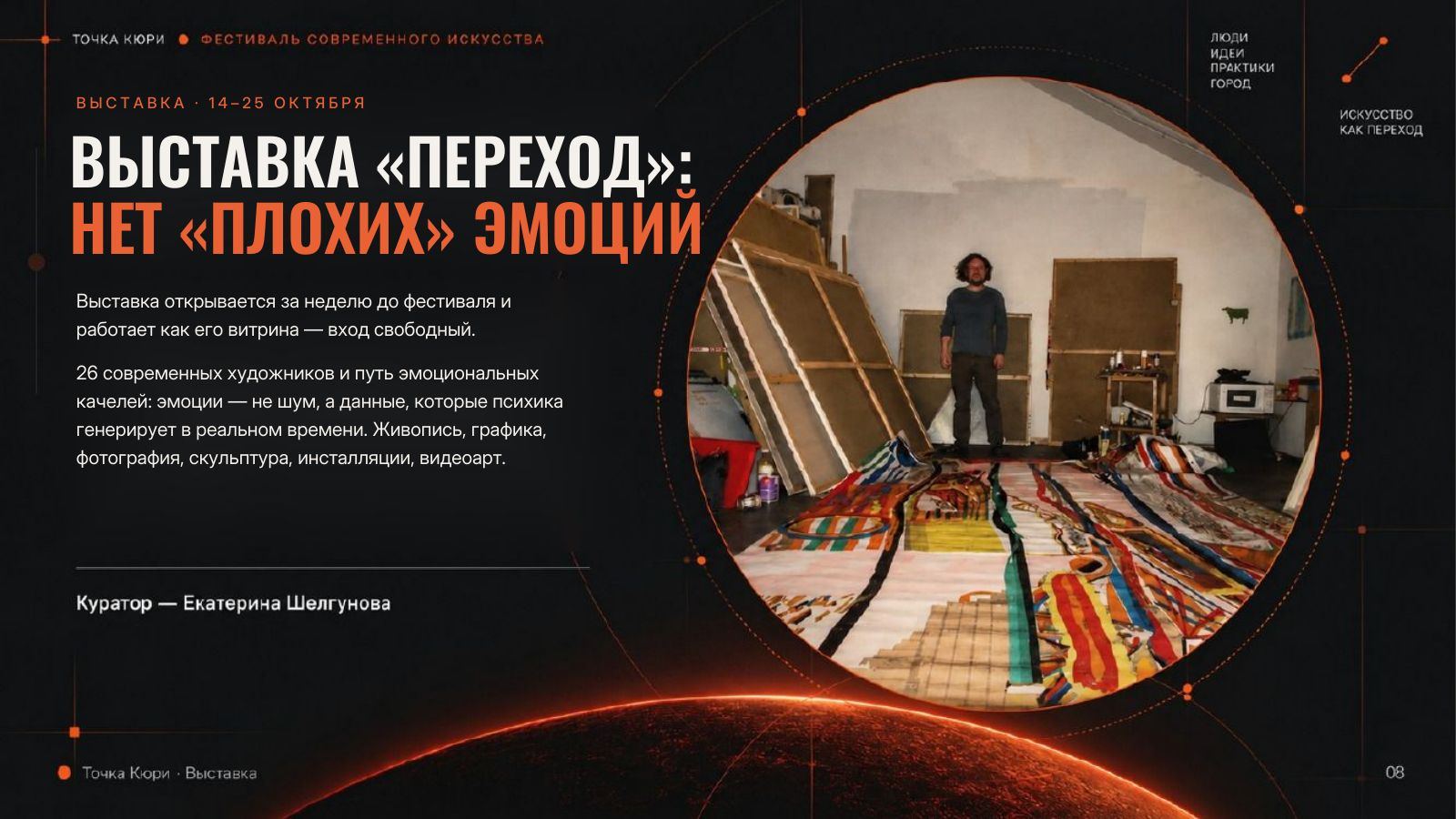
Thank you very much. Good afternoon. My name is Ekaterina Shelgunova, I am the curator of the art exhibition “Transition”, which I have presented here. It is what surrounds you — the exhibits that I would even say I found for this event. We are showing 22 contemporary — and, looking at what we have ended up with, I would say incredible — artists who helped me create the visual image you see here.
The concept of the exhibition is transition, an exploration of new forms and states of the human being and of nature. My task as a curator was to speak about a transition of state: about whether a person needs to change, what change is, how it happens, and perhaps to give the viewer a little push towards it. Conclusions should probably be drawn after viewing. My main task is for a person to perhaps think about something new, something unusual for them, and perhaps from that moment some real transition will begin.
Of course, we will get to know the artists’ works in more detail on the tour. You will be more immersed in the context of the theme and in the technical side — how the artist thought, how they worked — and that will give you your own experience of engaging with the works.
The theme of transition unfolds not only in the space of the exhibition. We also have a theatre programme, and it is a completely different way of experiencing change — through action, presence and live contact with the audience. I would like Viktor Ignatov to tell you more about his part of the programme.
Theatre programme
Thank you. Good afternoon, friends. I will try to be brief, but if I get a little carried away, Katya […]. I am an actor at the Stary Oskol theatre, my name is Viktor Ignatov. I will start with a little reflection and then move on to the festival itself.
Theatre is an art in which transition happens literally before the audience’s eyes. An actor moves from one inner state to another, the stage space becomes a completely different dimension. The audience comes to the theatre to immerse themselves in the circumstances, to change, and as a rule after the show they leave not quite the same as they came. It is very important to us that theatre is not just entertainment or a way to tell a story, but a tool for exploring the human being, the human soul — together: the stage experience and our own personal experience as actors and directors.
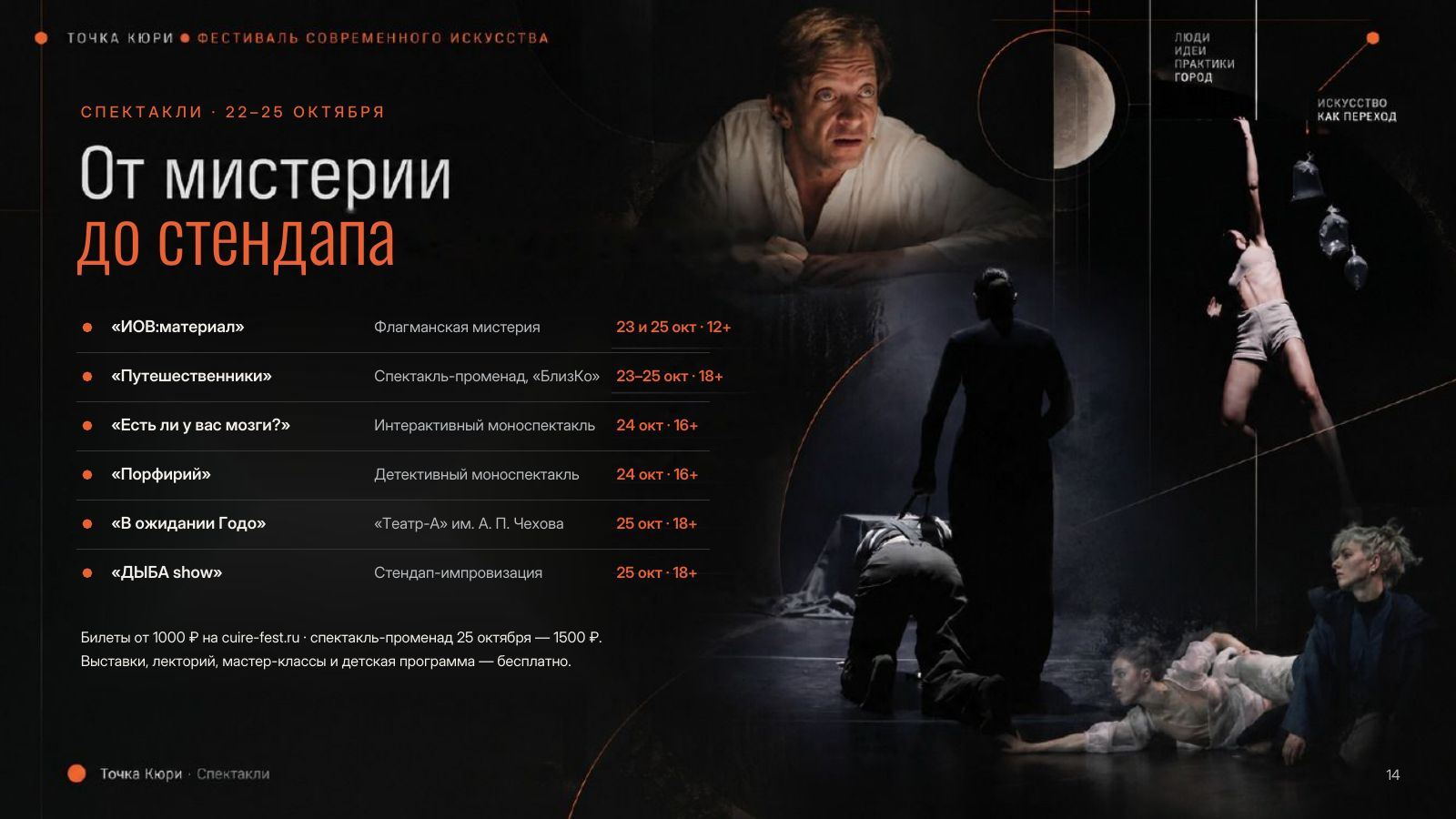
And our flagship show is “IOV: Material”, which will be shown three times: once as a closed performance and twice for everyone. We released it eight months ago in Kaluga. Its uniqueness (?) is that the text was written exclusively for the performers, and all three performances we played in Kaluga were unrepeatable and unlike each other — not in the usual sense of “today I’m in one mood, tomorrow in another”, but because of the interaction, the dialogue with the audience: with what energy the audience came today, how we feel each other. In this production we tried to move away — in the good sense of the word — from familiar, archaic theatrical devices and ways of being on stage, […], so that the viewer, watching this show, could use analytical thinking to find points of contact with themselves. Because the show is built on the experience of the director Katya Abdulova and on the personal experience of the performers. So first and foremost I invite you to this show. All the information is already on the website, and tickets are on sale.
Oh, yes! We played the premiere eight months ago, and to this day the text is being rewritten. Because, as has already been said, the world changes, you change, we performers change, the city where the show will be played changes — and accordingly the text changes, and perhaps even some of the meaning of the production.
Let me peek at my phone to tell you about the other shows. October 23, Friday, at 16:00 — the promenade show “The Travellers”. If I remember correctly, it will take place outdoors, starting at CSI “Byl”. It is a bit immersive — you will be co-participants in the show. But no one will deliberately touch you or make you do anything: you will be free people with the right to choose, you will move around […]. Also on October 23 — the show “IOV: Material”, directed by Katya Abdulova. It has only two actors and runs an hour twenty to an hour twenty-five. A very deep story that, I am sure, will resonate with everyone. Let it be a negative response, let it be a positive one — but you will see yourself there, that’s for sure.
October 24, Saturday: “The Travellers” promenade again; at 19:00 — the solo show “Porfiry”, Sasha Panov and Sveta Nikiforova.
October 25: “IOV: Material” at 14:00. Also at 14:00 in the small hall — the absurdist play “Waiting for Godot”, directed by Viktor Derinov, that’s Kaluga. And at 16:00 — “The Travellers” again.
So, friends, we will be glad and grateful if you come and if you invite your friends and family. I am sure — trite as it is to say — that the festival, the art exhibition and the shows will not leave you indifferent. Every spectator will leave in a state of transition — from one self to another and perhaps, however grandiose it sounds, to their true self.
Oh, yes! And on the evening of the 25th, at 20:00, on the closing day of the festival, we will have the stand-up comedian Ivan Dyba — I don’t know how well you know him. It will be improvised stand-up, about an hour to an hour and a half, complete improvisation with the audience. So thank you, my dears.
Thank you very much, Viktor. Indeed, people who come to the theatre always come for feelings, for some kind of reaction. And such an opportunity — to see different shows and feel yourself in different ways — is priceless (?). Thank you very much.
And of course at the show it may be a little unusual for our audience. But there will be nothing perverse, vulgar, crude and so on, right? Because the phrase “contemporary art” sounds, and “contemporary” here means relevant, resonating with today’s person. Only in that sense. So there is no need to be afraid of the word “contemporary”. Thank you.
Thank you. And now we want to turn to an art that acts on us not only through images and words, but directly through sound, rhythm, movement and visual form. Kseniya Shamarina will tell us a little about her part of the work.
Sound, music and the fashion show
My name is Kseniya Shamarina, and I curate the sound design and the sonic breathing of the festival. As such, we don’t have a music programme as a separate block, but there is a lot of sound in the programme. Sound accompanies absolutely every stage. Wherever you go, whatever tiny stretch of the way you step onto, you will meet sound everywhere. You may not even notice it. As, for example, right now: as soon as you entered the space, you were already gradually immersed in the atmosphere, and what immerses you is a finely woven fabric.
It is music from various shows — music that accompanies the finished shows coming to us. It is music created for the video art pieces you can watch and listen to at the exhibition — we have two video artists. And also here, on the top floor, the exhibition is accompanied by tracks that lead you through a transitional state from one work to another. They are arranged by theme and mood and flow into one another. […] We will also have a fashion show, and it will be very sound-driven too. In the fashion show we experiment with states — our whole programme is about states: inside, outside, and about how we reconcile incompatible things, try to fit into this world and reconcile within ourselves what seems impossible to reconcile. We will try to reveal this theme very broadly at the fashion show. I hope you like it — I will be very happy.
Viktor is prompting me that I absolutely must mention: I wrote the music for the show “IOV: Material”. All of it. Thank you.
Questions from journalists
Thank you very much. My friends, that is how we have told you about the “Tochka Cuire” festival in detail. Now you can ask questions — I hope you have some — to any of our participants, any of our speakers. Mikhail will help pass the microphone into the hall. Are there any questions about the exhibition?
Inaudible remark by Ekaterina Shelgunova about the tour
Great, thank you, Katya. My friends, are there any questions? Please raise your hand, introduce yourself and ask one of our speakers a question. Don’t be shy.
I have a purely practical question. I see the events are split into blocks, into strands. Is there some kind of summary, conventional, “non-transitional” table where everything is laid out by day, by hour and so on?
Yes, we have a website, and on the website there is an “Events” tab. Everything is listed there by day and by hour — a conventional table.
More questions? […] So, my friends, are there any more questions? Misha, let’s keep an eye on our guests’ wishes.
Good afternoon. Could you tell us, please, who are the actors in your shows?
In the shows we are bringing? There is currently a question about the physical theatre part of the programme — we are still finalising it. On the website we currently have shows from the New Stage of the Alexandrinsky Theatre, the dance group “OMUT”. They have been invited to film for a very big TV project that starts on October 27, and they have to get back to Saint Petersburg [at] 23:00, and then from there return to Moscow. In short, the physical theatre programme is up in the air right now, but it will definitely be settled today or tomorrow: either they will come off the website or they will make it after all. The physical theatre part consists of shows released at the New Stage of the Alexandrinsky Theatre in Saint Petersburg by the group “OMUT”: choreographer Nadezhda Kokhanova, the dancers of “OMUT”, producer Misha Kazmiruk.
The show “Waiting for Godot” is Viktor Derinov’s “Theatre-A” named after A. P. Chekhov, with the actors of his theatre, accordingly. In my show Vitya plays, along with one more actor who is not local.
The show “Porfiry” was created by Sasha Panov — an actor and director of the Taganka Theatre — and Sveta Nikiforova: she is from the Kaluga Regional Drama Theatre, an Honoured Artist of the Kaluga Region, and now also heads […] there. It is a show based on works by Akutagawa and texts by Fyodor Mikhailovich Dostoevsky. It explores the story of Porfiry from “Crime and Punishment” and opens it up. Sasha Panov performs in it himself, it is a solo show.
Also coming is a show by Dima Turkov. Dima Turkov is quite a well-known director, from Petersburg and Moscow. For several years he ran the Motygino Drama Theatre — the smallest theatre in a very remote point of Russia. And during the time Dima was artistic director and chief director, this theatre became known throughout Russia: from a simple municipal theatre it grew into a krai one, that is, in our terms, a regional one. Stories about them aired on all the federal TV channels. Dima Turkov made a very interesting show called “Do You Have a Brain?” — a show about the neuroplasticity of the brain. Seryozha Vasin plays in it — currently an actor of the Kaluga Youth Theatre, but in general he has played in a great many theatres.
And it’s worth saying, just in case, a small clarification: all the artists who will take part in the festival — this is not an amateur story. They are all professional working actors of Russian theatres.
The immersive show “The Travellers” is the creative laboratory “BlizKo” of Zhenya Sukhotina-Maslennikova — we keep mixing up her maiden and married names. Anyway, it is her theatre and the actors of her theatre.
And Vanya Dyba is not part of the theatre programme, but Vanka is actually great. Besides being quite a well-known stand-up comedian in Russia now, he has been working in art for a long time: he has a video production studio, he makes films, clips and podcasts, and sometimes acts in independent theatres. He is involved in a huge number of cultural and socially significant projects. When I found out he has a PhD in pedagogy, it was a discovery for me. By training he is an actor […], and now the whole of Russia knows him as a stand-up comedian. It’s funny. That’s the story. Yes, Vitya is right: there are no amateurs in our programme. Only professional actors, professional directors and a professional team making the project.
Thank you. More questions?
Yes, may I? My name is Ilya, hello. My question is probably for the whole team. If I understand correctly, as Ekaterina said, two months passed from idea to realisation? In that connection — you said there were a great many challenges, obstacles and difficulties. Could each team member say, for their own area, what was the hardest thing in all this work? Thank you.
The microphone comes to me first. For me personally the obstacle was distance, because you are very far away. The venue we were supposed to come to was completely unknown to me, I had never been to your city, and doing everything remotely is very hard, logistically hard. Even imagining from photos of the room what the volume is, what the acoustics are like — it is all very difficult. That’s for my part.
For me it was very hard — it probably won’t sound nice to say this, but I will. I am a working actor, we just had a premiere at the theatre, lots of rehearsals, constantly at work here at the theatre. And for me it was hard to accept that Katya, Ksyusha, Katya — the whole team, really — were literally working 24/7, and they were sparing me. What was hard wasn’t even that they spared me, but that they didn’t let me work as hard as they did. Thank you.
Well, I don’t even know. I have got so used to these changes of state. You know, you live your ordinary normal life, and then: “Oops, we need to make a festival.” And for the next two months you live in a completely different state of mind, with a set of technical tasks, a set of creative tasks, a set of communication and team tasks. I don’t know what the difficulty is. Organising a festival is always hard, because a huge number of parts have to be joined into a single whole.
Probably distance is the hardest thing. During the preparation we have come here, to the venue, for the third time. The first time for one day, the second for three days, and now we have been here on installation for the third day. And it isn’t over yet: now we will finish the press conference, go and assemble my set, and then drive to Kaluga. […] No, you are not going to Petersburg, you will go to Petersburg after the festival. Yes, distance is probably the hardest thing. Otherwise I am wildly delighted with your city, the venue, the people. I’m in love. Thank you.
May I say what our biggest difficulties probably are? The hardest thing is getting through to people, to the audience. Katya gives us the opportunity to learn to interact in our projects directly with spectators and co-participants. Why? Because we want you to understand: for us what we do is something we cannot not do, while for you it is something you may or may not take in. We would like to tell you with all our strength that we really want you to come to us and take a little part in the life of our centre, in the life of our city, and gain the experience (?) that the whole team of the festival and of all our projects is ready to share with you.
And one more very important point: since the young generation is sitting here, our wonderful spectators have been invited — we have a show you can attend with the Pushkin Card. Not only is there a Pushkin Card bonus — you can simply get together with friends and go. It is a very good bonus to get to know the show and the actors, to give yourself the chance to accept this practice — contemplation, co-participation — and to get some kind of reaction, an answer.
Yes, we also have a discount on tickets with the Pushkin Card.
That’s right. So, I think we have told you everything. What other questions are there, friends?
Tell us, please, where does the name come from?
At the festival I will host a big open conversation — it will go through the universe of Luc Besson’s films and will be called “Landscapes of Reality”. All my life I have been occupied and fascinated by one question — and what I admire most in people — the capacity for change. Because if a system becomes closed, if a person stops developing, or if that development never begins at all, we go on living inside the scripts we inherited. Unfortunately, that is a dead system — it is just that the physical form does not yet match what is inside, but that is bound to happen. Our life is often filled with dead waste, and there is no space for life in our life.
I would like this festival to become annual, for it to come to life. And I want us to explore the point of transition in the first season. When we started looking for a name for this concept — and we had never explored terminology from the world of physics, literally — we came across this term, and it impressed us so much. And only then did we choose the city. That is, we came to you not because you are somewhere nearby, or for some other reason. Actually, choosing Stary Oskol right now to host a contemporary art festival is an adventure, to put it mildly. But we couldn’t not do it. We are not guided by any commercial or other priorities. You are simply in a unique place, and the theme of our festival matches the identity of your city one hundred percent.
Thank you. Are there any more questions, guys? Then may I ask Kseniya a question — perhaps one of the closing ones. Why exactly did a fashion show become part of a contemporary art festival?
A fashion show precisely because the designers who create clothing are also a very important key. Just as, in living, we don’t notice sounds because they are so woven into our lives that they feel natural — we don’t pay attention to how many things, clothes and fabrics are around us, simply because it is natural for us. And that is important to take into account. Here we look at space, at objects, at fabric, at wood, at textures. Clothing is also an important part of our lives, which is why we invited designers. And this clothing will be woven into a theatrical staging that directly reveals the theme (?) of the festival. So we can’t do without them here: we have tried to show as much as possible of the familiar things that matter but that we ignore.
Closing
Thank you very much. Indeed, I was also involved a little in a contemporary fashion festival, and I find the movement of our Russian designers very interesting — they are opening up in a truly amazing way right now. Perhaps now is exactly their time — to open up, to show their full potential and to show everyone in our country that our own work is also in demand, that there are unique authors of unique collections. I invite you to get to know them — it is very interesting and, most importantly, distinctive. Because all the cultures that inhabit our country very actively preserve their cultural code, their identity, precisely in clothing, and for some reason only Russians try not to talk about it. But now that very change is happening, when our designers read and convey that inner, cultural code in clothing in a different way. It is great, it is very impressive.
On that note, I think we can end our press conference. I thank all the participants, all the speakers. Once again I invite you to the festival, which will run from the 22nd to the 25th. And now we invite you to the exhibition — to get to know the display. And please, I ask you to give feedback to your friends and comrades, to tell them about what is happening at “Tochka Cuire”, so that this event that our guests have prepared… Well, you have to agree, it really is an adventure. Why? Because our whole country lives, you could say, in one rhythm, and we in a slightly different one. And this mismatch keeps us from opening up fully: at some moments we cannot announce very loudly. That is why we need your help. Please tell people about it, come, bring friends, parents, grandmothers, grandfathers, nephews, brothers. Everyone come to us from the 22nd to the 25th! Thank you all very much.
Moving on to the tour; no further speech
The “Tochka Cuire” festival is held with the support of the Department of Culture of the Stary Oskol City District Administration and the Metalloinvest company.